
Frequent load-shedding, long commutes and phones that struggle to last until evening mean a power bank has become an everyday essential. The problem is choice. With hundreds of models on the market, how do you find the best power bank for your own routine? This guide explains capacity, brands, safety and price in plain language so you can buy with confidence.
How Much Capacity Do You Need?
Power bank capacity is measured in mAh (milliamp hours). Because some energy is lost as heat during charging, expect roughly 60 to 70 percent of the printed capacity to reach your phone. A typical phone battery is 4,500 to 5,000mAh, so the maths looks like this:
| Capacity | Approx. full phone charges | Best for |
|---|---|---|
| 10,000mAh | 1.5 | Daily commute, light users |
| 20,000mAh | 3 | Weekend trips, charging two devices |
| 25,000mAh | 3.5 to 4 | Families, heavy users, long journeys |
A power bank 25000mah unit is about 92Wh, which still sits under the 100Wh limit most airlines allow. Remember that power banks must always travel in hand luggage, never in checked baggage.
Choose a Brand You Can Trust
Inflated mAh numbers are common on unbranded units. If you are looking for the best power bank brand, check three things: genuine user reviews, clear safety protections (over-current, over-heat and short-circuit) and a warranty you can actually claim. A good power bank brand will also print the real watt-hour rating on the casing.
Many shoppers search for the best anker power bank because Anker has built a reputation for reliable cells and fast-charging technology. Whichever brand you pick, match the model to your needs rather than chasing the biggest number.
Features for Camping and Outdoor Use
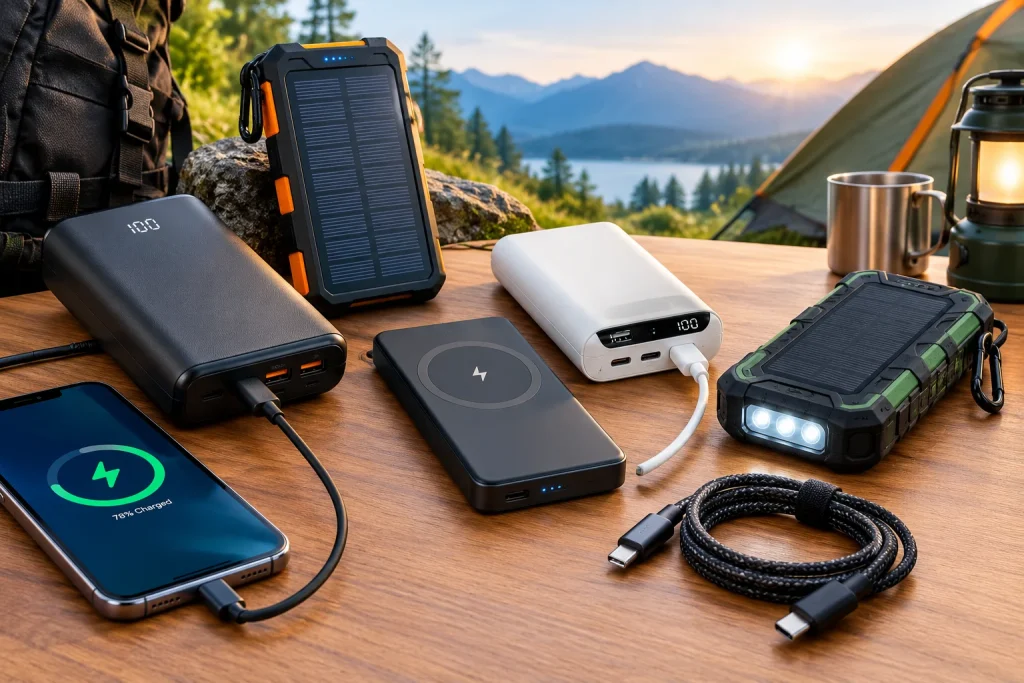
A camping power bank should be rugged, ideally dust and splash resistant, and include a built-in LED torch. Large capacity matters more than slim size here, because you may be away from a socket for days.You will also see a solar power bank in outdoor shops. Be realistic: the small built-in panel charges very slowly, so treat it as an emergency top-up, not your main charging method. A separate foldable solar phone charger panel is more effective, but it still needs strong, direct sunlight.
Cheap Versus Good Value
A cheap power bank can be fine for occasional use, but extremely low prices often hide recycled cells or exaggerated capacity. The power bank price you pay is shaped mainly by four things: real capacity, output power in watts, brand quality, and extras such as wireless charging or a digital display. Spending a little more usually buys better safety, which matters for a device you rely on every day.
Quick Safety Checklist
Buy from a seller that offers a return policy and warranty
Avoid units that get very hot while charging
Use the cable that came with your phone, or a quality replacement
Never leave a power bank charging under a pillow or on a bed
Our Picks at MobiGadgets
Need power for a laptop and a phone together? See our 65W 20000mAh Fast Charging Power Bank. Want something slim that snaps onto your phone? Take a look at the 10000mAh Magnetic Wireless Power Bank.
Final Thoughts
The right choice balances capacity, safety and price for how you actually live. Decide how many charges you need, pick a trusted brand and skip unrealistic bargains. Browse the full range at MobiGadgets and find the power bank that fits your day.
Frequently Asked Questions
How long does a 20,000mAh power bank take to recharge?
With a 18W to 30W input it usually takes 4 to 6 hours. A basic 10W adapter can take more than 10 hours.
Do power banks wear out?
Yes. Lithium cells slowly lose capacity after several hundred charge cycles. Avoid leaving the unit fully drained for weeks, and keep it away from heat.
Can I carry one on a flight?
Yes, in your carry-on bag. Units under 100Wh are generally accepted, but always confirm your airline’s current rules.
